

Overview
The Ask User module is a built-in module that allows agents to pause execution and request clarification from users through structured questions instead of proceeding with assumptions. When enabled, agents can present 1-4 questions with selectable options and optional free-text input, then resume with the answers injected into the execution context. Key Capabilities:- Pause agent execution to ask clarifying questions
- Present multiple-choice questions with 2-4 options
- Support single-select and multi-select question types
- Allow free-text “Other” input for custom answers
- Display questions in stepwise navigation with progress indicators
- Resume execution with structured answers
The Ask User module must be enabled in your agent configuration or project settings. It is off by default for new conversations and agents.
Prerequisites
- Agent or Conversation: The module must be enabled for the specific agent or conversation.
- Interactive Session: The module works in interactive sessions where users can respond to questions.
- Non-Interactive Behavior: In non-interactive or API runs, the module auto-skips and returns reasonable defaults.
How It Works
When the Ask User module is enabled, the agent gains access to a tool that can pause execution and present structured questions to the user. The module uses the platform Human-In-The-Loop (HITL) pipeline:- Agent pauses when it needs clarification or faces ambiguous requirements
- Questions display in a stepwise pager with single-select or multi-select options
- User answers by selecting options or entering free-text when allowed
- Agent resumes with answers injected as tool results
- Execution continues with the clarification information
- Single question shows only Submit button
- Multiple questions show Back/Next navigation controls
- Progress indicator displays “Question X of Y”
- Questions appear one per step
- Navigation gated until current question receives an answer
Enabling Ask User
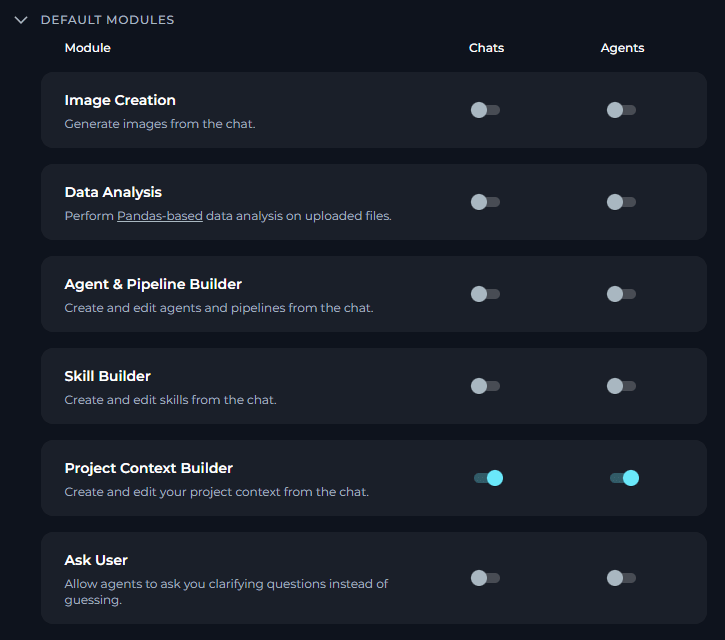
You can enable Ask User in three ways: as a default setting for all new chats and agents, for a specific conversation, or in an individual agent configuration.In Project Settings
- Navigate to Settings in the main menu.
- Go to the General section.
- Find the Ask User row under default modules.
- Toggle Chats on to enable Ask User by default for all new conversations.
- Toggle Agents on to enable Ask User by default for all new agents.
-
Click Save.
In a Conversation
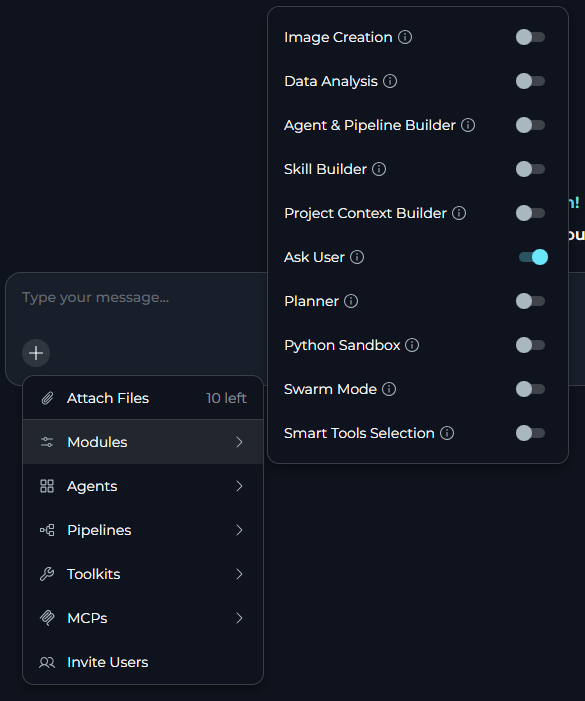
- Navigate to your conversation.
-
Click the
+icon in the chat input toolbar. - Hover over Modules to open the flyout panel.
- Find Ask User in the list and toggle it on.
-
A success notification appears: “Modules configuration updated”.
In Agent Configuration
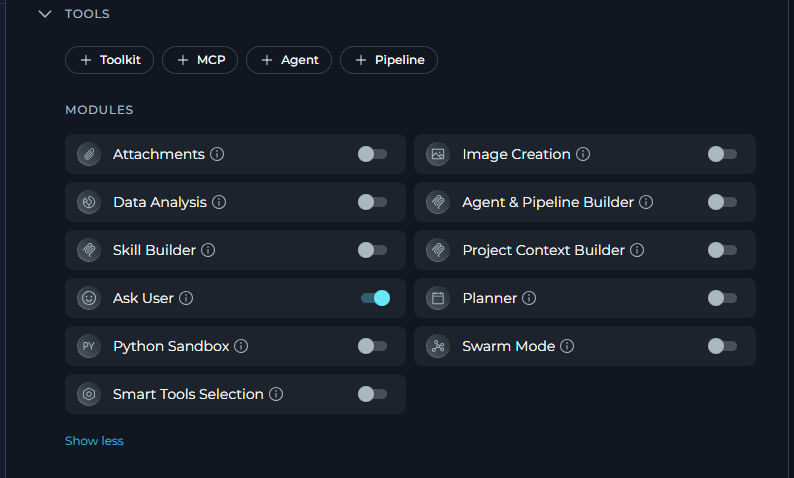
- Navigate to Agents in the main menu.
- Select the agent you want to configure or create a new agent.
- In the TOOLS section, locate the MODULES subsection.
- Find the Ask User toggle (click Show all if needed).
- Toggle Ask User on.
-
Click Save.
Using Ask User
How Questions Appear
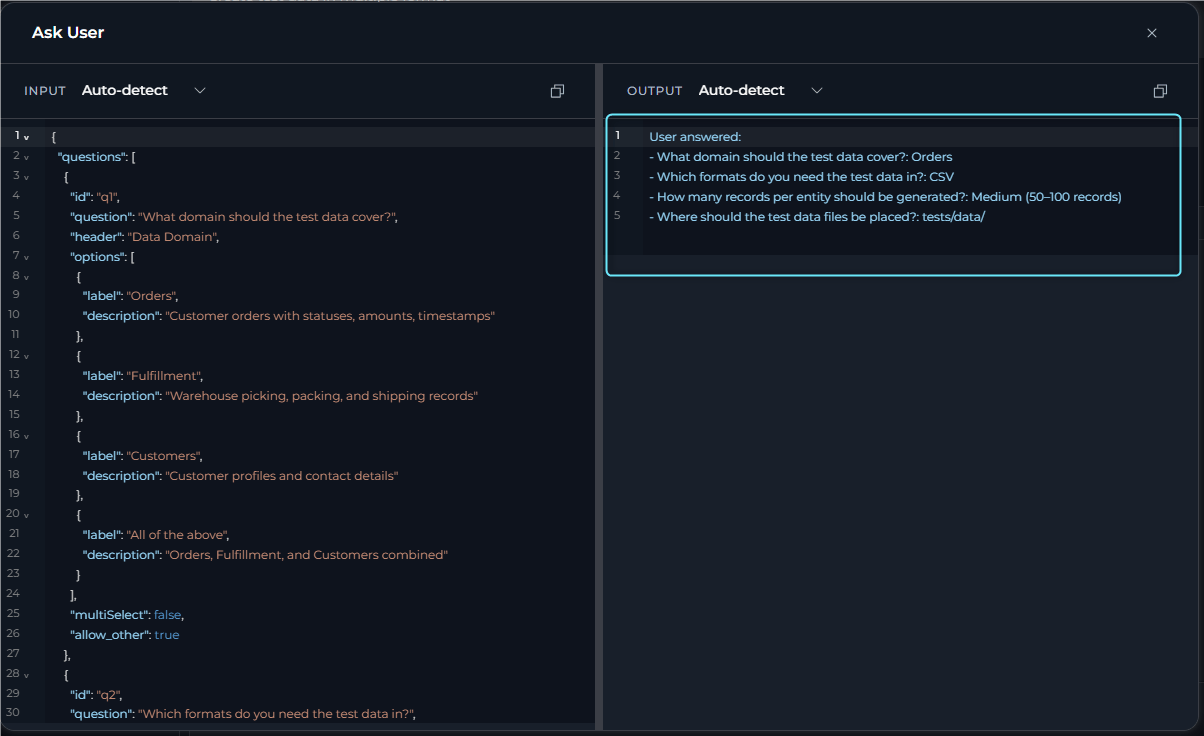
When a conversation encounters ambiguous requirements or missing information, execution can pause and present structured clarifying questions. Example Scenario: You request to create a test data but do not provide all required information. If Ask User is enabled, the conversation pauses and presents focused questions: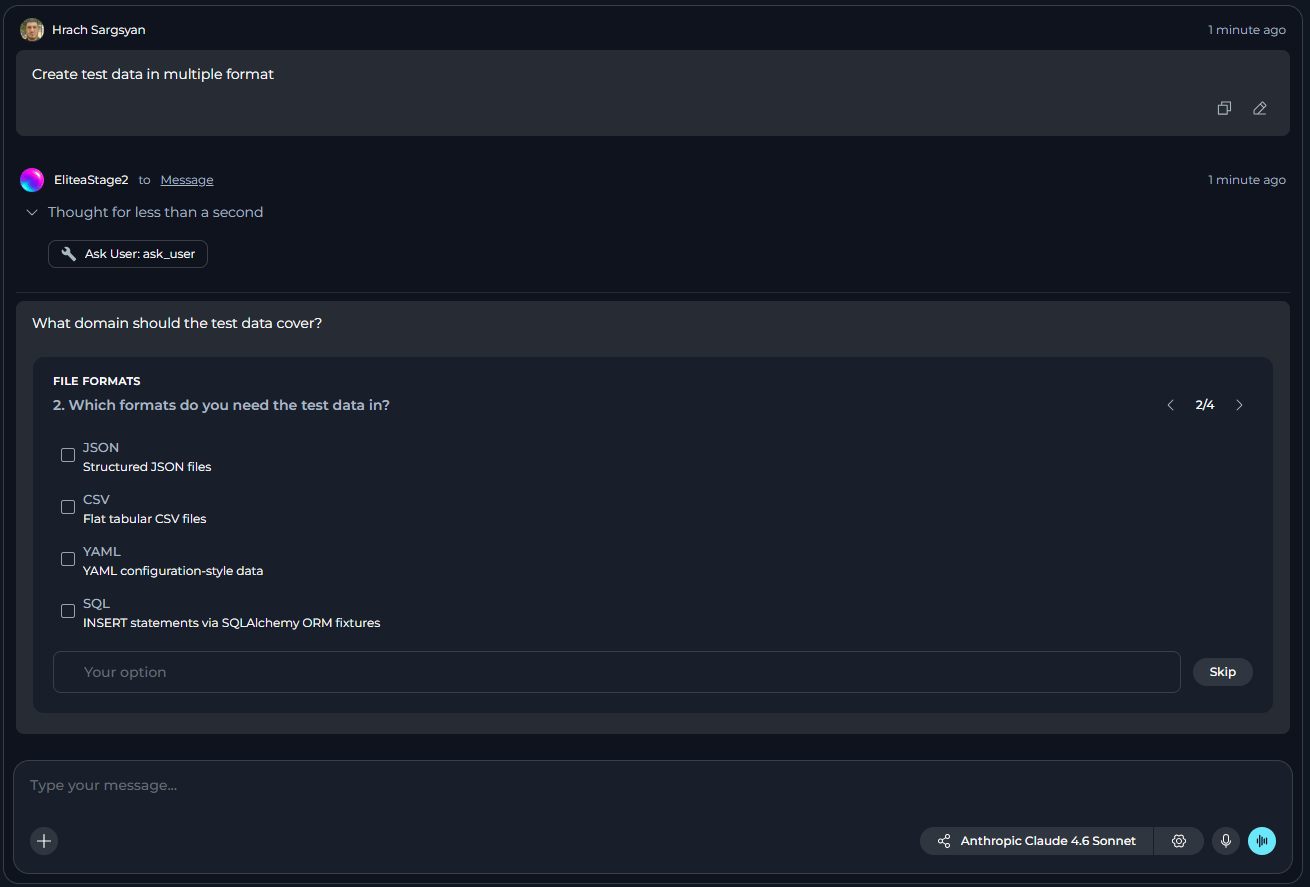
- Single question: Continue button applies the answer
- Multiple questions: Back and Continue buttons navigate between questions
- Progress indicator: Shows “Question X of Y” for multi-question flows
- Skip option: Available to skip answering and proceed without providing clarification
Answering Questions
Step 1: Review the Question Read the question header and description. Review available options with their descriptions. Step 2: Select Your Answer- For single-select: Click one option
- For multi-select: Click one or more options
- For free-text: Enter custom text in the “Other” field (when allowed)
- Click Continue to proceed to the next question (saves current answer)
- Click Back to return to previous questions
- Click Skip to skip answering and continue without clarification
- After the last question, click Continue to apply all answers
Best Practices
Enable with Builder Modules
Enable with Builder Modules
Always enable Ask User alongside Skill Builder and Project Context Builder modules. This provides the best experience:
- With Ask User enabled: Agents present structured clarifying questions (1-4 questions) with interactive options when skill or project context requests are missing information.
- Without Ask User: Agents can only request missing information through normal chat responses, requiring multiple back-and-forth exchanges.
- In Project Settings: Toggle Ask User, Skill Builder, and Project Context Builder under Default Modules
- In Agent Configuration: Enable all three modules in the MODULES section
- In Conversations: Enable all three from the Modules flyout panel
When to Use
When to Use
- Enable Ask User for agents that create or configure resources (skills, project context, agents)
- Enable for agents that perform complex tasks with multiple valid approaches
- Enable when working with agents that handle ambiguous or incomplete requirements
- Disable for fully automated or API-driven workflows where user interaction is not possible
Question Design
Question Design
Agents design questions to gather specific information:
- Questions focus on genuine decision points (approach, target, configuration)
- Options provide 2-4 distinct choices when possible
- Descriptions explain what choosing each option means
- Free-text “Other” field available when flexibility is needed
- Questions do not ask permission to run tools (agents should have appropriate permissions)
Module Configuration
Module Configuration
- Enable Ask User by default in Project Settings if your team frequently works with builder modules
- Enable Ask User for agents that create or manage project resources
- Disable Ask User for agents in automated pipelines or API-only environments
- Review agent behavior with Ask User to ensure questions are meaningful
Working with Questions
Working with Questions
- Answer all questions before submitting to avoid incomplete clarification
- Use the “Other” field to provide specific details not covered by options
- Navigate back to review or change previous answers before submitting
- Provide complete information upfront in your request to minimize clarification rounds
Limitations
- Off by default: Must be explicitly enabled for each conversation or agent.
- Interactive sessions only: Auto-skips in non-interactive or API runs.
- Question limit: Agents can ask 1-4 questions per pause.
- Navigation gating: Must answer current question before proceeding to next.
- No nested pauses: Agent cannot pause again while a clarifying question is pending.
- Skill Builder - Module that benefits from Ask User integration
- Project Context Builder - Module that benefits from Ask User integration
- Agents - How to configure agents and enable modules
- Chat - Conversation features and module management