> ## Documentation Index
> Fetch the complete documentation index at: https://docs.elitea.ai/llms.txt
> Use this file to discover all available pages before exploring further.
# Index TestRail Data
> Indexing tools are available in the Next environment (Release 1.7.0) and replace legacy Datasources/Datasets. For context, see Release Notes 1.7.0 and the Index
Indexing tools are available in the [Next environment](https://next.elitea.ai) (Release 1.7.0) and replace legacy Datasources/Datasets. For context, see [Release Notes 1.7.0](../../release-notes/archived/rn13#indexing-dedicated-toolkit-indexes-tab) and the [Indexing Overview](./indexing-overview).
## Overview
TestRail indexing allows you to create searchable indexes from your TestRail test management content:
* **Test Cases**: Detailed test procedures, steps, expected results, and custom fields
* **Test Projects**: Project structures, test suites, and section organization
* **Test Metadata**: Test priorities, types, automation status, and custom properties
* **Attachments**: Screenshots, test files, documentation, and media attached to test cases
* **Test History**: Test execution results, comments, and version tracking
**What you can do with indexed TestRail data:**
* **Semantic Search**: Find test cases and procedures across projects using natural language queries
* **Context-Aware Chat**: Get AI-generated answers from your test documentation with citations to specific test cases
* **Cross-Project Discovery**: Search across multiple TestRail projects and test suites
* **Test Analysis**: Analyze testing patterns, coverage, and procedures for quality improvement
* **Knowledge Extraction**: Transform test documentation into searchable organizational knowledge
**Common use cases:**
* Finding similar test cases across projects to avoid duplication and ensure consistency
* Onboarding new QA team members by allowing them to ask questions about testing procedures and standards
* Analyzing test coverage gaps and identifying areas needing additional test cases
* Support teams searching for existing test procedures when investigating issues
* Test managers extracting insights from test documentation for reporting and process improvement
***
## Prerequisites
Before indexing TestRail data, ensure you have:
1. **TestRail Credential**: A TestRail API key with [authentication credentials](../credentials-toolkits/how-to-use-credentials#testrail-credential-setup) configured in ELITEA
2. **Vector Storage**: PgVector selected in Settings → [AI Configuration](../../menus/settings/ai-configuration)
3. **Embedding Model**: Selected in AI Configuration (defaults available) → [AI Configuration](../../menus/settings/ai-configuration)
4. **TestRail Toolkit**: Configured with your TestRail instance details and credentials
### Required Permissions
Your TestRail credential needs appropriate permissions based on what you want to index:
**For Content Access:**
* Read access to TestRail projects and test cases
* Permission to view the specific projects you want to index
**For Comprehensive Indexing:**
* Access to view test case attachments (if including attachments)
* Permission to view test case history and metadata
* Access to both active and archived projects (based on your requirements)
**Authentication Method:**
* **TestRail API Key**: Email address and API key generated in TestRail
***
## Step-by-Step: Creating a TestRail Credential
1. **Generate TestRail API Key** in your TestRail account (My Settings → API Keys → Add Key)
2. **Create Credential in ELITEA**: Navigate to **Credentials** → **+ Create** → **TestRail** → enter details and save
For complete credential setup steps including API key generation and security best practices, see:
* [Create a Credential](../../getting-started/create-credential)
* [TestRail Credential Setup](../credentials-toolkits/how-to-use-credentials#testrail-credential-setup)
* [TestRail Toolkit Integration Guide](../../integrations/toolkits/testrail_toolkit)
***
## Step-by-Step: Configure TestRail Toolkit
1. **Create Toolkit**: Navigate to **Toolkits** → **+ Create** → **TestRail**
2. **Configure Settings**: Set TestRail instance URL and assign your TestRail credential
3. **Enable Tools**: Select `Index Data`, `List Collections`, `Search Index`, `Stepback Search Index`, `Stepback Summary Index`, and `Remove Index` tools
4. **Save Configuration**
### Tool Overview:
* **Index Data**: Creates searchable indexes from TestRail test cases and documentation
* **List Collections**: Lists all available collections/indexes to verify what's been indexed
* **Search Index**: Performs semantic search across indexed content using natural language queries
* **Stepback Search Index**: Advanced search that breaks down complex questions into simpler parts for better results
* **Stepback Summary Index**: Generates summaries and insights from search results across indexed content
* **Remove Index**: Deletes existing collections/indexes when you need to clean up or start fresh
### Configuration Settings:
| Setting | Description | Example Value |
| -------------------- | ----------------------------------- | ------------------------------------- |
| **URL** | TestRail instance URL | `https://yourcompany.testrail.io/` |
| **Email** | TestRail account email address | `test.manager@company.com` |
| **Password/API Key** | TestRail API key for authentication | Select from Secrets or enter directly |
Use the complete TestRail instance URL including `https://` and your subdomain (e.g., `https://yourcompany.testrail.io/`).
For complete toolkit configuration including URL setup and authentication options, see:
* [Toolkits Menu](../../menus/toolkits)
* [TestRail Toolkit Integration Guide](../../integrations/toolkits/testrail_toolkit)
***
## Step-by-Step: Index TestRail Data
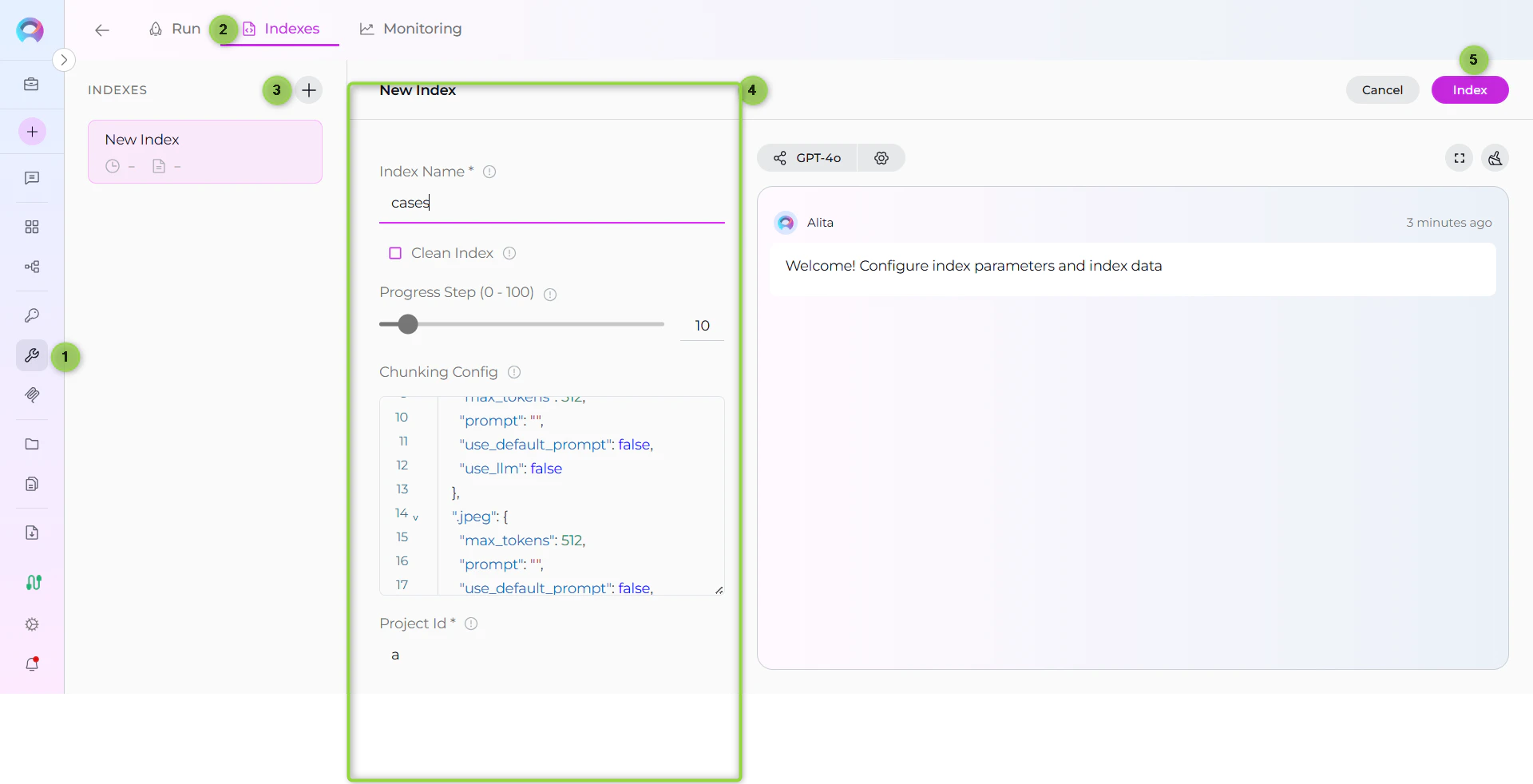
All indexing operations are performed via the **Indexes Tab Interface**. This dedicated interface provides comprehensive index management with visual status indicators, real-time progress monitoring, and integrated search capabilities.
Before proceeding, ensure your project has PgVector and Embedding Model configured in Settings → AI Configuration, and your TestRail toolkit has the **Index Data** tool enabled.
### Step 1: Access the Interface
1. **Navigate to Toolkits**: Go to **Toolkits** in the main navigation
2. **Select Your TestRail Toolkit**: Choose your configured TestRail toolkit from the list
3. **Open Indexes Tab**: Click on the **Indexes** tab in the toolkit detail view
If the tab is disabled or not visible, verify that:
* PgVector and Embedding Model are configured in Settings → AI Configuration
* The **Index Data** tool is enabled in your toolkit configuration
### Step 2: Create a New Index
1. **Click Create New Index**: In the Indexes sidebar, click the **+ Create New Index** button
2. **New Index Form**: The center panel displays the new index creation form
### Step 3: Configure Index Parameters
Fill in the required and optional parameters for your TestRail indexing:
| Parameter | Required | Description | Example Value |
| ---------------------------- | -------- | --------------------------------------------------- | -------------------------------------------- |
| Index Name | ✓ | Suffix for collection name (max 7 chars) | `cases` or `qa` |
| Clean Index | ✗ | Remove existing index data before re-indexing | ✓ (checked) or ✗ (unchecked) |
| Progress Step (0 - 100) | ✗ | Step size for progress reporting during indexing | `10` (default) |
| Chunking Config | ✗ | Configuration settings for content chunking | `{"chunk_size": 4000, "chunk_overlap": 200}` |
| Chunking Tool | ✗ | Method for splitting content into chunks | `json` (default) |
| project\_id | ✓ | TestRail project ID to index data from | `1` or `5` |
| suite\_id | ✗ | Optional TestRail suite ID to filter test cases | `3` or leave empty |
| section\_id | ✗ | Optional section ID to filter test cases | `15` or leave empty |
| include\_attachments | ✗ | Whether to include attachment content in indexing | ✓ (checked) or ✗ (unchecked) |
| skip\_attachment\_extensions | ✗ | File extensions to skip when processing attachments | `[".png", ".jpg"]` |
### Step 4: Start Indexing
1. **Form Validation**: The **Index** button remains inactive until all required fields are filled
2. **Review Configuration**: Verify all parameters are correct
3. **Click Index Button**: Start the indexing process
4. **Monitor Progress**: Watch real-time updates with visual indicators:
* 🔄 **In Progress**: Indexing is currently running
* ✅ **Completed**: All items indexed successfully
* ⚠️ **Partially Indexed**: Indexing finished but some files were skipped (unsupported extension, empty content, or errors). The index is fully usable for search and scheduling — review the skipped-file breakdown in the chat panel.
* ❌ **Failed**: Indexing encountered an error
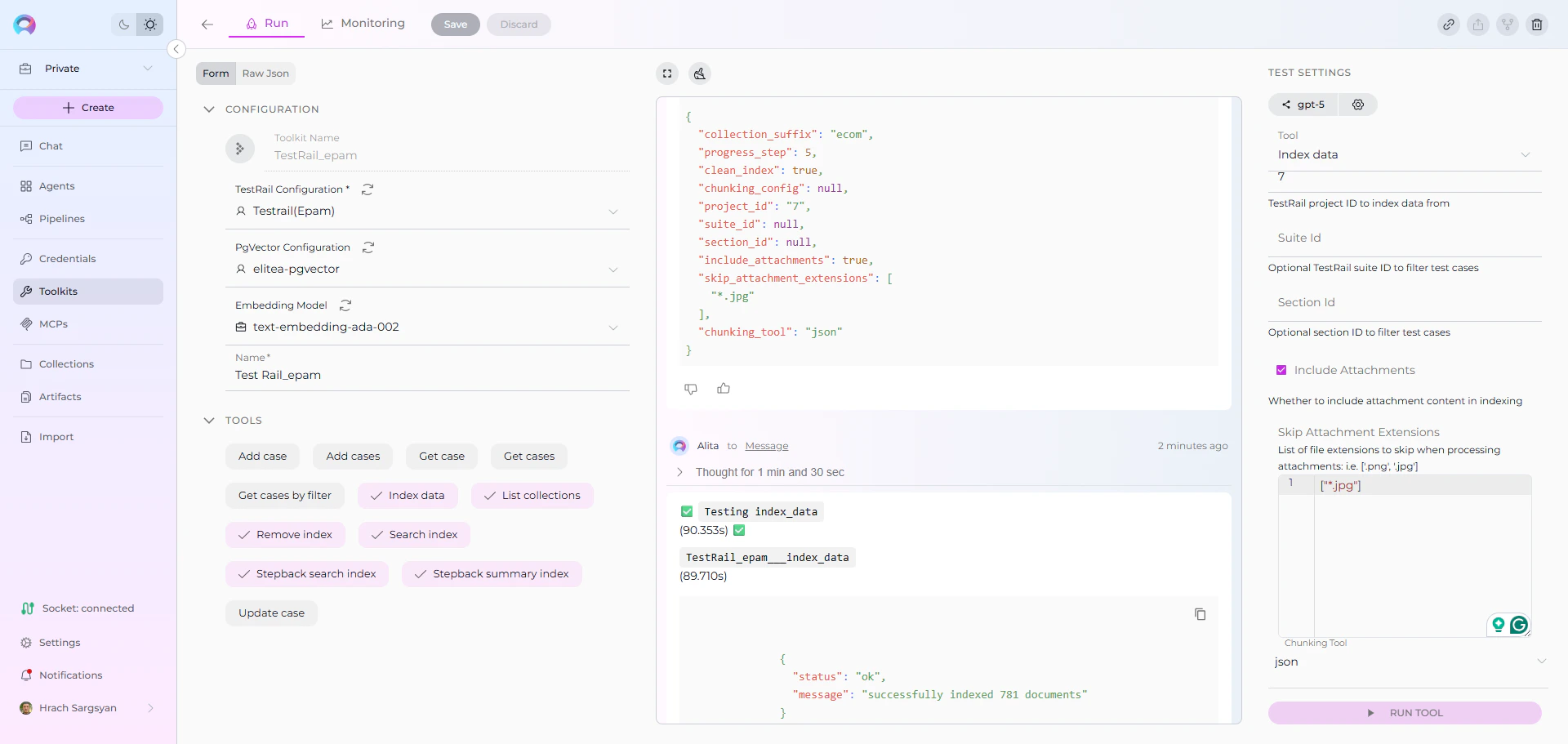
 For quick testing and validation, you can also use the **Test Settings** panel on the right side of the toolkit detail page. Select a model, choose the **Index Data** tool from the dropdown, configure parameters, and click **Run Tool**. However, the Indexes Tab Interface is the recommended approach for comprehensive index management.
### Step 5: Verify Index Creation
After indexing completes, verify the index was created successfully:
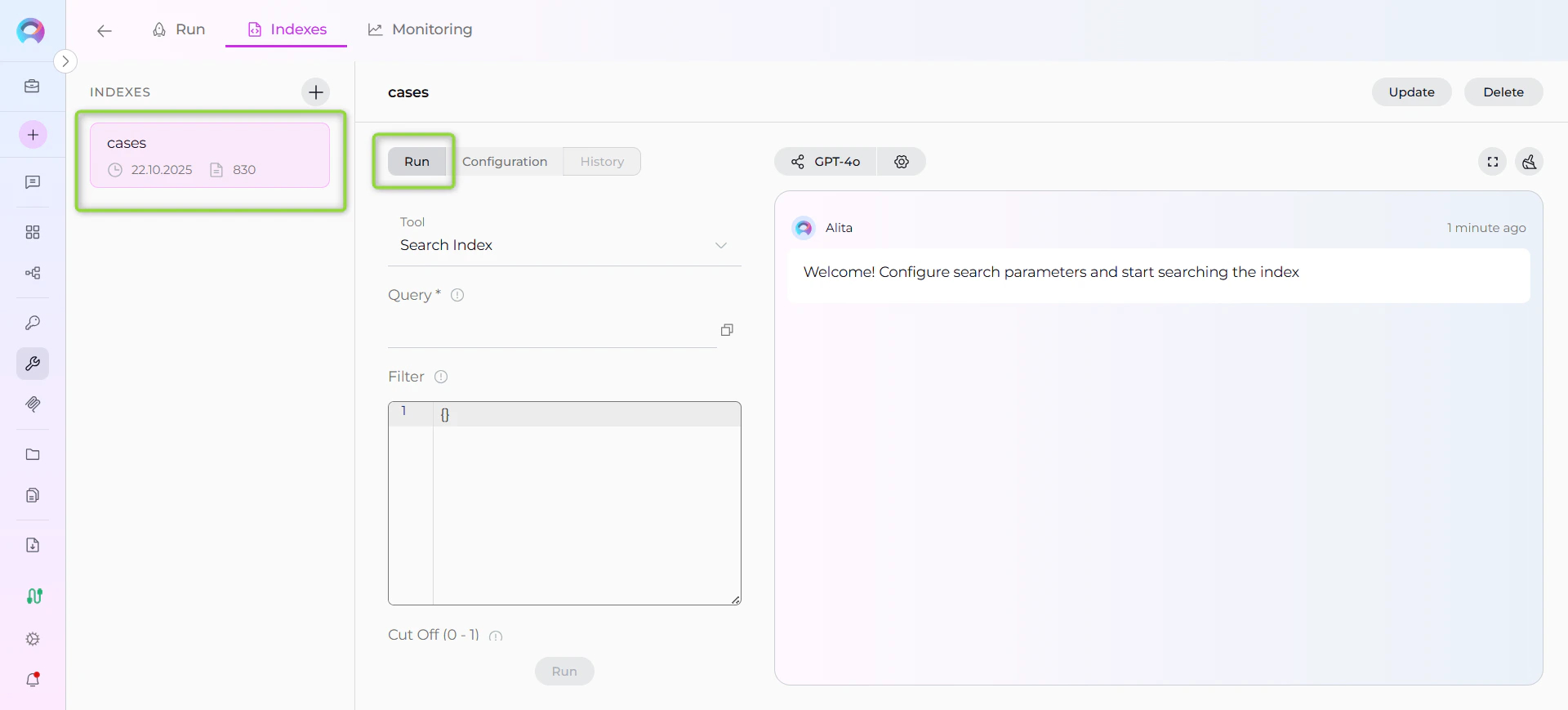
1. **Check Index Status**: Visual indicators show completion status
2. **Review Index Details**: Click on the created index to see metadata and document count
3. **Test Search**: Use the **Run** tab to test search functionality with sample queries
### Real-Life Example: Indexing QA Test Documentation
**Scenario**: You have a QA team with comprehensive test documentation in TestRail for an e-commerce web application. You want to make all test cases, procedures, and testing knowledge searchable for team collaboration and knowledge sharing.
**Indexing Steps:**
1. **Configure TestRail Toolkit:**
* URL: `https://yourcompany.testrail.io/`
* Email: `qa.manager@yourcompany.com`
* API Key: Generated from TestRail → My Settings → API Keys
2. **Index Complete E-commerce Project:**
* Project ID: `1`
* Collection suffix: `ecom`
* Progress Step: `5` (report every 5 test cases)
* Clean Index: ✓ (for fresh start)
* Include Attachments: ✓ (for test screenshots and documentation)
* Skip Attachment Extensions: `[".jpg"]`
* Chunking Tool: `json`
* Chunking Config: Default
For quick testing and validation, you can also use the **Test Settings** panel on the right side of the toolkit detail page. Select a model, choose the **Index Data** tool from the dropdown, configure parameters, and click **Run Tool**. However, the Indexes Tab Interface is the recommended approach for comprehensive index management.
### Step 5: Verify Index Creation
After indexing completes, verify the index was created successfully:
1. **Check Index Status**: Visual indicators show completion status
2. **Review Index Details**: Click on the created index to see metadata and document count
3. **Test Search**: Use the **Run** tab to test search functionality with sample queries
### Real-Life Example: Indexing QA Test Documentation
**Scenario**: You have a QA team with comprehensive test documentation in TestRail for an e-commerce web application. You want to make all test cases, procedures, and testing knowledge searchable for team collaboration and knowledge sharing.
**Indexing Steps:**
1. **Configure TestRail Toolkit:**
* URL: `https://yourcompany.testrail.io/`
* Email: `qa.manager@yourcompany.com`
* API Key: Generated from TestRail → My Settings → API Keys
2. **Index Complete E-commerce Project:**
* Project ID: `1`
* Collection suffix: `ecom`
* Progress Step: `5` (report every 5 test cases)
* Clean Index: ✓ (for fresh start)
* Include Attachments: ✓ (for test screenshots and documentation)
* Skip Attachment Extensions: `[".jpg"]`
* Chunking Tool: `json`
* Chunking Config: Default
 3. **Index Specific Test Suite (Optional):**
* Project ID: `1`
* Suite ID: `10` (only User Authentication Tests)
* Collection suffix: `auth`
* Include Attachments: ✗ (authentication tests rarely have attachments)
4. **Index Specific Section (Optional):**
* Project ID: `1`
* Suite ID: `20`
* Section ID: `203` (only Checkout Process tests)
* Collection suffix: `checkout`
* Include Attachments: ✓ (checkout tests often have payment screenshots)
5. **Verify indexing:**
* Use "List Collections" tool to confirm collections exist
* Expected collections: `ecom`, `auth`, `checkout`
* Check indexing output for test case processing confirmation
3. **Index Specific Test Suite (Optional):**
* Project ID: `1`
* Suite ID: `10` (only User Authentication Tests)
* Collection suffix: `auth`
* Include Attachments: ✗ (authentication tests rarely have attachments)
4. **Index Specific Section (Optional):**
* Project ID: `1`
* Suite ID: `20`
* Section ID: `203` (only Checkout Process tests)
* Collection suffix: `checkout`
* Include Attachments: ✓ (checkout tests often have payment screenshots)
5. **Verify indexing:**
* Use "List Collections" tool to confirm collections exist
* Expected collections: `ecom`, `auth`, `checkout`
* Check indexing output for test case processing confirmation
 **After indexing, you can search for:**
* **Authentication queries**: *"Find all test cases for user login functionality"*
* **Feature-specific tests**: *"What are the steps to test the shopping cart feature?"*
* **Cross-functional testing**: *"Show me test cases that verify payment processing"*
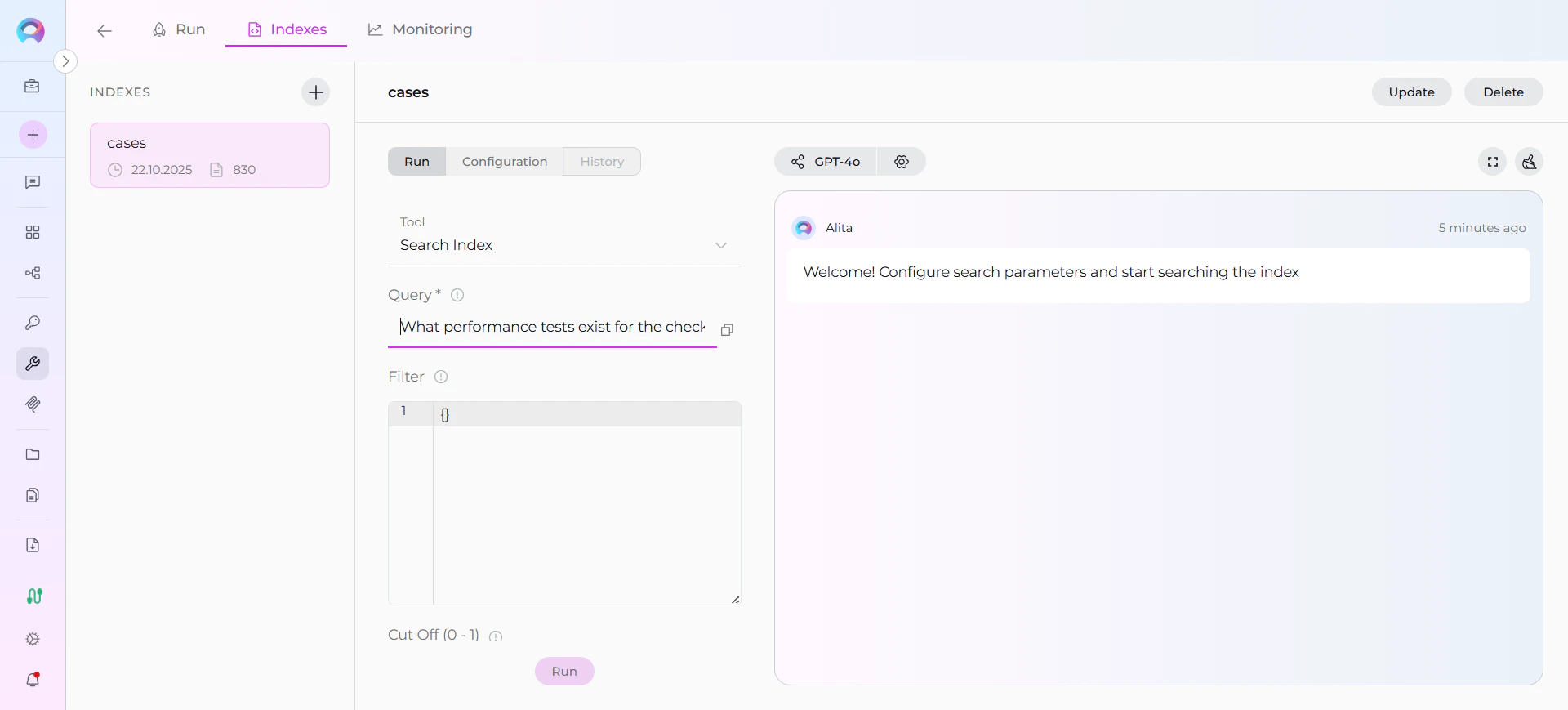
* **Performance analysis**: *"What performance tests exist for the checkout process?"*
* **Test coverage gaps**: *"Are there tests for guest checkout without registration?"*
***
## Search and Chat with Indexed Data
Once your TestRail data is indexed, you can use it in multiple ways:
### Using the Indexes Interface
**Direct Search via Indexes Tab:**
1. **Access Indexes Tab**: Navigate to your TestRail toolkit → **Indexes** tab
2. **Select Index**: Click on your created index from the sidebar
3. **Open Run Tab**: Click the **Run** tab in the center panel
4. **Choose Search Tool**: Select from available search tools:
* **Search Index**: Basic semantic search
* **Stepback Search Index**: Advanced search with question breakdown
* **Stepback Summary Index**: Summarized insights from search results
5. **Enter Query**: Type your natural language question
6. **View Results**: See responses with citations to specific test cases
**After indexing, you can search for:**
* **Authentication queries**: *"Find all test cases for user login functionality"*
* **Feature-specific tests**: *"What are the steps to test the shopping cart feature?"*
* **Cross-functional testing**: *"Show me test cases that verify payment processing"*
* **Performance analysis**: *"What performance tests exist for the checkout process?"*
* **Test coverage gaps**: *"Are there tests for guest checkout without registration?"*
***
## Search and Chat with Indexed Data
Once your TestRail data is indexed, you can use it in multiple ways:
### Using the Indexes Interface
**Direct Search via Indexes Tab:**
1. **Access Indexes Tab**: Navigate to your TestRail toolkit → **Indexes** tab
2. **Select Index**: Click on your created index from the sidebar
3. **Open Run Tab**: Click the **Run** tab in the center panel
4. **Choose Search Tool**: Select from available search tools:
* **Search Index**: Basic semantic search
* **Stepback Search Index**: Advanced search with question breakdown
* **Stepback Summary Index**: Summarized insights from search results
5. **Enter Query**: Type your natural language question
6. **View Results**: See responses with citations to specific test cases
 ### Using Toolkit in Conversations and Agents
Your TestRail toolkit can be used in two main contexts:
1. **In Conversations**: Add the toolkit as a participant to ask questions and search your indexed TestRail data
2. **In Agents**: Include the toolkit when creating AI agents to give them access to your test documentation
**How to use:**
* **Start a New Conversation or Create an Agent**
* **Add Toolkit as Participant**: Select your TestRail toolkit from the available toolkits
* **Ask Natural Language Questions**: The toolkit will automatically search your indexed data and provide relevant answers with citations
### Using Indexed TestRail Data in Conversations
Let's walk through a complete example of querying indexed test documentation:
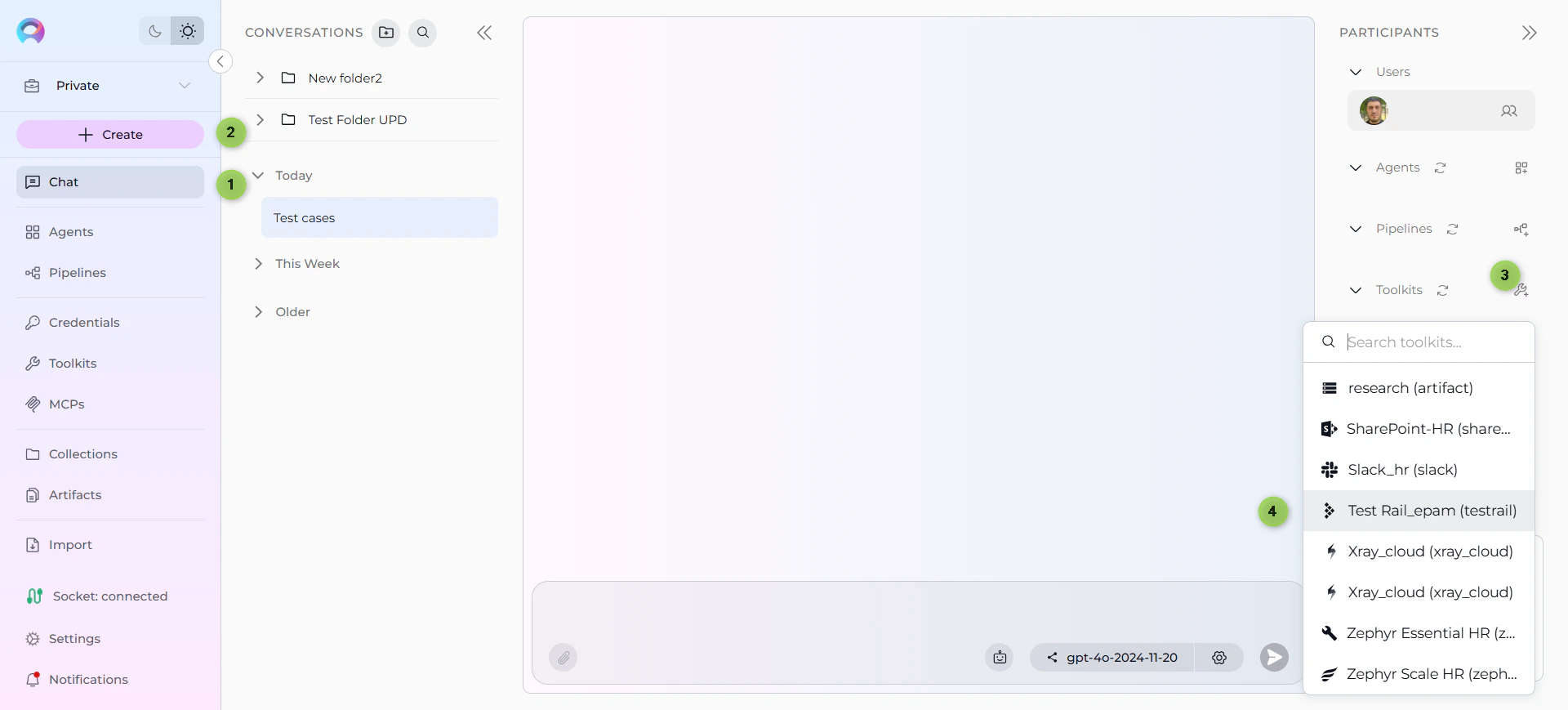
**Step 1: Add toolkit to a conversation and start asking questions:**
* Navigate to **Chat** → **+ Create**
* In the participants section click + to add Toolkit
* Select your TestRail toolkit from the available toolkits list
### Using Toolkit in Conversations and Agents
Your TestRail toolkit can be used in two main contexts:
1. **In Conversations**: Add the toolkit as a participant to ask questions and search your indexed TestRail data
2. **In Agents**: Include the toolkit when creating AI agents to give them access to your test documentation
**How to use:**
* **Start a New Conversation or Create an Agent**
* **Add Toolkit as Participant**: Select your TestRail toolkit from the available toolkits
* **Ask Natural Language Questions**: The toolkit will automatically search your indexed data and provide relevant answers with citations
### Using Indexed TestRail Data in Conversations
Let's walk through a complete example of querying indexed test documentation:
**Step 1: Add toolkit to a conversation and start asking questions:**
* Navigate to **Chat** → **+ Create**
* In the participants section click + to add Toolkit
* Select your TestRail toolkit from the available toolkits list
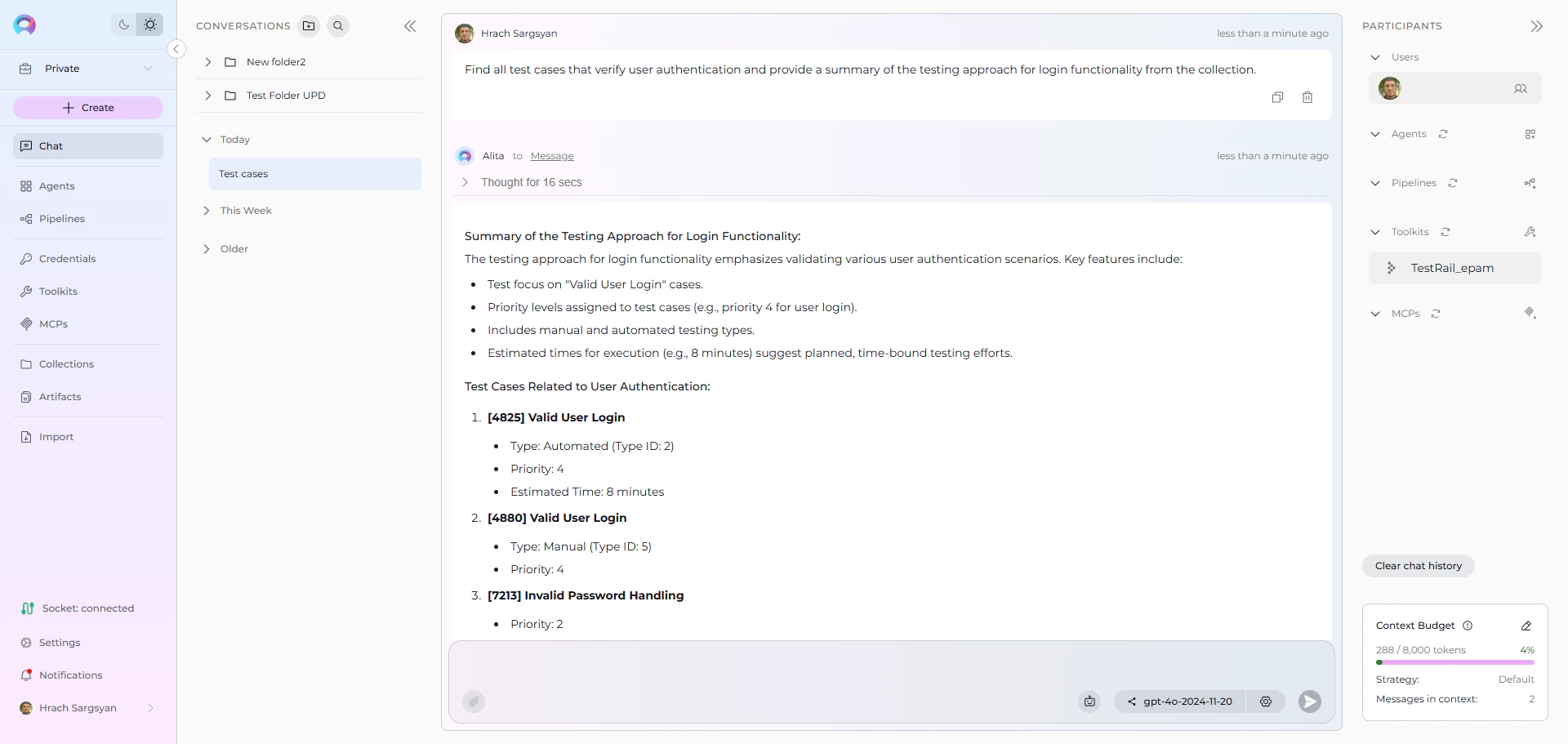
 **Step 2: Start comprehensive analysis with your indexed test documentation**
* **User Request:** "Find all test cases that verify user authentication and provide a summary of the testing approach for login functionality from the collection."
* **TestRail Toolkit:** "Based on your indexed test cases, here's a comprehensive summary of user authentication testing:
**User Authentication Test Cases Found:**
1. **TC-4825: Valid User Login**: Verifies successful login with correct credentials
2. **TC-7213: Invalid Password Handling**: Tests error messages for incorrect passwords
3. **TC-003: Account Lockout Protection**: Validates account security after multiple failed attempts
4. **TC-004: Two-Factor Authentication**: Tests 2FA implementation and verification process
5. **TC-012: Session Timeout**: Verifies automatic logout after inactivity period
**Testing Approach Summary:**
**Positive Testing:**
* Valid credential combinations across different user roles
* Successful authentication flow validation
* Session management and persistence testing
**Negative Testing:**
* Invalid credential handling and error messaging
* Security boundary testing (brute force protection)
* Edge cases for special characters and input validation
**Security Testing:**
* Password encryption verification
* Session token security validation
* Multi-factor authentication workflows
*Sources: TC-4285 (Project: Web Application Testing), TC-7213 (Suite: User Authentication Tests), TC-003, TC-004, TC-012*"
**Step 2: Start comprehensive analysis with your indexed test documentation**
* **User Request:** "Find all test cases that verify user authentication and provide a summary of the testing approach for login functionality from the collection."
* **TestRail Toolkit:** "Based on your indexed test cases, here's a comprehensive summary of user authentication testing:
**User Authentication Test Cases Found:**
1. **TC-4825: Valid User Login**: Verifies successful login with correct credentials
2. **TC-7213: Invalid Password Handling**: Tests error messages for incorrect passwords
3. **TC-003: Account Lockout Protection**: Validates account security after multiple failed attempts
4. **TC-004: Two-Factor Authentication**: Tests 2FA implementation and verification process
5. **TC-012: Session Timeout**: Verifies automatic logout after inactivity period
**Testing Approach Summary:**
**Positive Testing:**
* Valid credential combinations across different user roles
* Successful authentication flow validation
* Session management and persistence testing
**Negative Testing:**
* Invalid credential handling and error messaging
* Security boundary testing (brute force protection)
* Edge cases for special characters and input validation
**Security Testing:**
* Password encryption verification
* Session token security validation
* Multi-factor authentication workflows
*Sources: TC-4285 (Project: Web Application Testing), TC-7213 (Suite: User Authentication Tests), TC-003, TC-004, TC-012*"
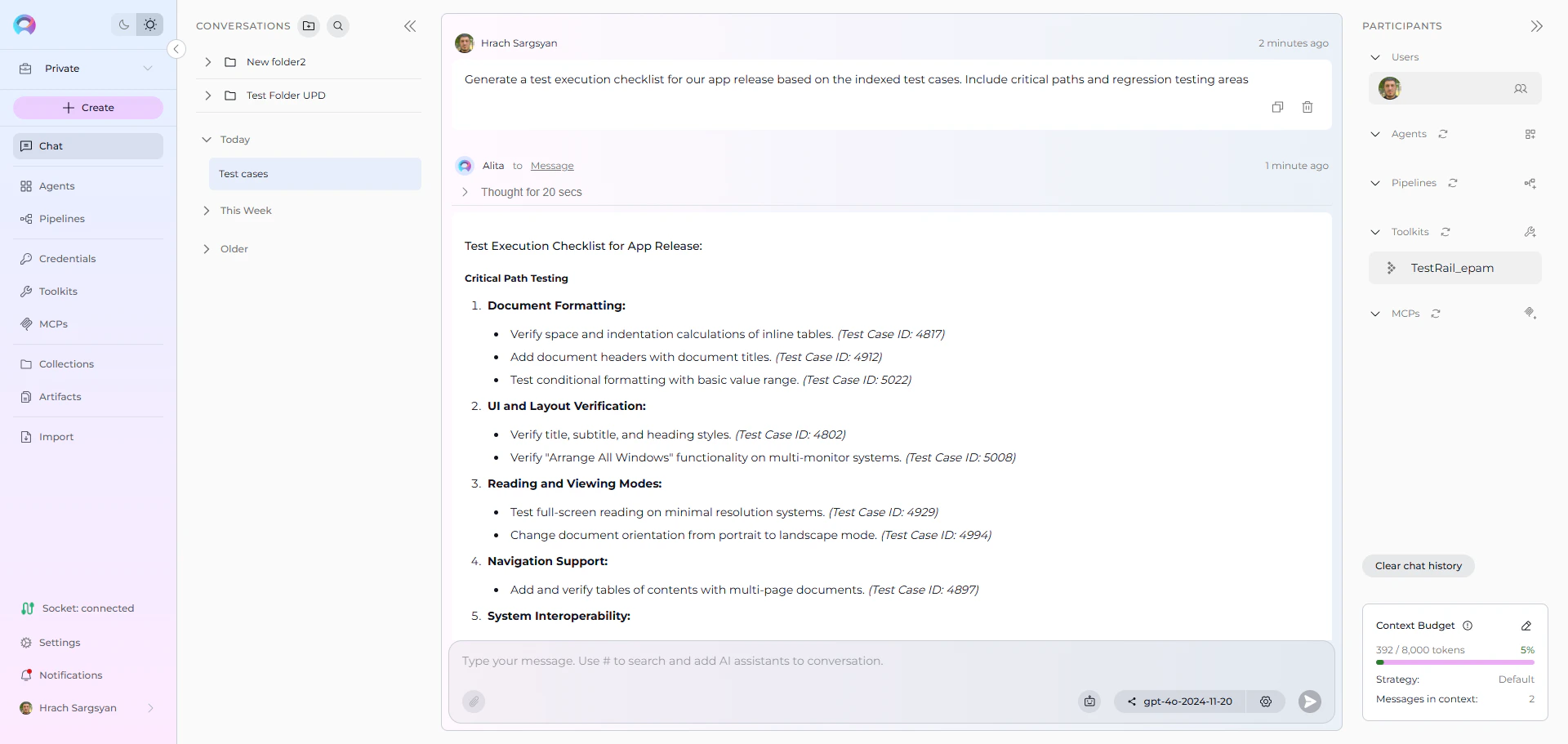
 * **User Request:** "Generate a test execution checklist for our app release based on the indexed test cases. Include critical paths and regression testing areas."
* **TestRail Toolkit:** "Based on your indexed mobile app test documentation, here's a comprehensive test execution checklist for release validation:
**MOBILE APP RELEASE TEST CHECKLIST**
**Critical Path Testing (Must Pass):**
* Document Formatting:
* UI and Layout Verification
* Payment Processing & Transaction Handling
* Data Synchronization (Online/Offline)
* Reading and Viewing Modes
* App Store Compliance & Guidelines
**Regression Testing Areas:**
**Functionality Regression:**
* User profile management and settings
* Search and filtering capabilities
* Social sharing and integration features
* In-app purchases and subscription management
**Platform-Specific Testing:**
* iOS: Touch ID/Face ID authentication
* Android: Background app behavior and permissions
* Cross-platform: UI consistency and responsive design
**Performance & Stability:**
* App launch time and memory usage
* Battery consumption during extended use
* Network connectivity handling (WiFi/Cellular/Offline)
* Device compatibility across OS versions
**Security & Privacy:**
* Data encryption and secure storage
* API security and authentication tokens
* User consent and privacy settings
* Biometric authentication security
*Sources: Mobile Test Suite (15 test cases), Performance Tests (8 test cases), Security Tests (6 test cases)*"
* **User Request:** "Generate a test execution checklist for our app release based on the indexed test cases. Include critical paths and regression testing areas."
* **TestRail Toolkit:** "Based on your indexed mobile app test documentation, here's a comprehensive test execution checklist for release validation:
**MOBILE APP RELEASE TEST CHECKLIST**
**Critical Path Testing (Must Pass):**
* Document Formatting:
* UI and Layout Verification
* Payment Processing & Transaction Handling
* Data Synchronization (Online/Offline)
* Reading and Viewing Modes
* App Store Compliance & Guidelines
**Regression Testing Areas:**
**Functionality Regression:**
* User profile management and settings
* Search and filtering capabilities
* Social sharing and integration features
* In-app purchases and subscription management
**Platform-Specific Testing:**
* iOS: Touch ID/Face ID authentication
* Android: Background app behavior and permissions
* Cross-platform: UI consistency and responsive design
**Performance & Stability:**
* App launch time and memory usage
* Battery consumption during extended use
* Network connectivity handling (WiFi/Cellular/Offline)
* Device compatibility across OS versions
**Security & Privacy:**
* Data encryption and secure storage
* API security and authentication tokens
* User consent and privacy settings
* Biometric authentication security
*Sources: Mobile Test Suite (15 test cases), Performance Tests (8 test cases), Security Tests (6 test cases)*"
 ***
## Best Practices
### Test Documentation Organization
* **Use descriptive project names** that reflect the application or feature being tested
* **Organize test cases by functionality** for better search results and coverage analysis
* **Include clear test steps and expected results** to improve indexing quality and searchability
### Indexing Strategy
* **Use clear collection suffixes** to separate different test projects (e.g., `web`, `mobile`, `api`)
* **Clean index periodically** when test documentation changes significantly
* **Include attachments** when test cases contain important screenshots or documentation files
### Search Optimization
* **Use natural language queries** rather than specific test case IDs
* **Be specific about testing areas** for better results (e.g., "authentication tests" vs "login")
* **Try different search tools** for various use cases:
* Basic questions: Search Index
* Complex analysis: Stepback Search Index
* Test planning: Stepback Summary Index
### Content Management
* **Update indexes** when adding significant new test cases or projects
* **Remove outdated collections** using the Remove Index tool
* **Maintain test case organization** in TestRail for better indexing results
***
## Common Issues and Troubleshooting
### Indexes Interface Issues
**"Indexes tab not visible" or "Tab disabled":**
* Verify PgVector and Embedding Model are configured in Settings → AI Configuration
* Ensure the **Index Data** tool is enabled in your TestRail toolkit configuration
* Check that your toolkit supports indexing (TestRail is supported)
* Refresh the browser page and retry
**"+ Create New Index button not working":**
* Verify all project-level prerequisites are met (PgVector and Embedding Model)
* Check that you have proper permissions for the toolkit
* Ensure the toolkit is properly saved with credentials
### No Test Cases Found During Indexing
**Problem**: Index Data tool reports no test cases to process
**Solutions:**
* Verify Project ID is correct and exists in your TestRail instance
* Check that your API key has read permissions for the specified project
* Confirm the project contains test cases and is not empty
### Authentication Errors
**Problem**: "Unauthorized" or "Access Denied" errors during indexing
**Solutions:**
* Verify your TestRail URL format includes `https://` and correct subdomain
* Check that your API key is valid and has not been revoked
* Ensure your TestRail account has appropriate permissions for the target project
### Poor Search Results
**Problem**: Search queries return irrelevant or no results
**Solutions:**
* Try more specific, detailed search queries related to testing terminology
* Adjust the **Cut Off** score (lower for more results, higher for precision)
* Use Stepback Search Index for complex testing questions
* Verify the Collection Suffix targets the right dataset
### Indexing Fails for Specific Test Cases
**Problem**: Some test cases fail to process during indexing
**Solutions:**
* Check if test cases have corrupt attachments or unsupported file formats
* Verify Suite ID and Section ID are valid if using filters
* Review indexing output for specific error messages
* Try indexing without attachment inclusion first, then add attachments
### Collection Not Found
**Problem**: Search tools can't find the specified collection
**Solutions:**
* Use List Collections tool to see available collections
* Verify collection suffix matches what was used during indexing
* Confirm indexing completed successfully
* Check for typos in collection suffix
***
For additional information and detailed setup instructions, see:
* **[Indexing Overview](./indexing-overview)** - *Complete guide to ELITEA's indexing system and capabilities*
* **[Indexing Tools](./indexing-tools)** - *Detailed reference for all indexing tools and parameters*
* **[TestRail Toolkit Guide](../../integrations/toolkits/testrail_toolkit)** - *Comprehensive guide to the TestRail Toolkit and its capabilities*
* **[How to Use Credentials](../credentials-toolkits/how-to-use-credentials#testrail-credential-setup)** - *TestRail credential setup and management*
* **[AI Configuration](../../menus/settings/ai-configuration)** - *Set up vector storage and embedding models for indexing*
* **[Toolkits Menu](../../menus/toolkits)** - *General toolkit configuration and management*
* **[Chat Menu](../../menus/chat)** - *Create conversations and add toolkits as participants*
* **[Agents Menu](../../menus/agents)** - *Create AI agents with access to your indexed TestRail data*
***
***
## Best Practices
### Test Documentation Organization
* **Use descriptive project names** that reflect the application or feature being tested
* **Organize test cases by functionality** for better search results and coverage analysis
* **Include clear test steps and expected results** to improve indexing quality and searchability
### Indexing Strategy
* **Use clear collection suffixes** to separate different test projects (e.g., `web`, `mobile`, `api`)
* **Clean index periodically** when test documentation changes significantly
* **Include attachments** when test cases contain important screenshots or documentation files
### Search Optimization
* **Use natural language queries** rather than specific test case IDs
* **Be specific about testing areas** for better results (e.g., "authentication tests" vs "login")
* **Try different search tools** for various use cases:
* Basic questions: Search Index
* Complex analysis: Stepback Search Index
* Test planning: Stepback Summary Index
### Content Management
* **Update indexes** when adding significant new test cases or projects
* **Remove outdated collections** using the Remove Index tool
* **Maintain test case organization** in TestRail for better indexing results
***
## Common Issues and Troubleshooting
### Indexes Interface Issues
**"Indexes tab not visible" or "Tab disabled":**
* Verify PgVector and Embedding Model are configured in Settings → AI Configuration
* Ensure the **Index Data** tool is enabled in your TestRail toolkit configuration
* Check that your toolkit supports indexing (TestRail is supported)
* Refresh the browser page and retry
**"+ Create New Index button not working":**
* Verify all project-level prerequisites are met (PgVector and Embedding Model)
* Check that you have proper permissions for the toolkit
* Ensure the toolkit is properly saved with credentials
### No Test Cases Found During Indexing
**Problem**: Index Data tool reports no test cases to process
**Solutions:**
* Verify Project ID is correct and exists in your TestRail instance
* Check that your API key has read permissions for the specified project
* Confirm the project contains test cases and is not empty
### Authentication Errors
**Problem**: "Unauthorized" or "Access Denied" errors during indexing
**Solutions:**
* Verify your TestRail URL format includes `https://` and correct subdomain
* Check that your API key is valid and has not been revoked
* Ensure your TestRail account has appropriate permissions for the target project
### Poor Search Results
**Problem**: Search queries return irrelevant or no results
**Solutions:**
* Try more specific, detailed search queries related to testing terminology
* Adjust the **Cut Off** score (lower for more results, higher for precision)
* Use Stepback Search Index for complex testing questions
* Verify the Collection Suffix targets the right dataset
### Indexing Fails for Specific Test Cases
**Problem**: Some test cases fail to process during indexing
**Solutions:**
* Check if test cases have corrupt attachments or unsupported file formats
* Verify Suite ID and Section ID are valid if using filters
* Review indexing output for specific error messages
* Try indexing without attachment inclusion first, then add attachments
### Collection Not Found
**Problem**: Search tools can't find the specified collection
**Solutions:**
* Use List Collections tool to see available collections
* Verify collection suffix matches what was used during indexing
* Confirm indexing completed successfully
* Check for typos in collection suffix
***
For additional information and detailed setup instructions, see:
* **[Indexing Overview](./indexing-overview)** - *Complete guide to ELITEA's indexing system and capabilities*
* **[Indexing Tools](./indexing-tools)** - *Detailed reference for all indexing tools and parameters*
* **[TestRail Toolkit Guide](../../integrations/toolkits/testrail_toolkit)** - *Comprehensive guide to the TestRail Toolkit and its capabilities*
* **[How to Use Credentials](../credentials-toolkits/how-to-use-credentials#testrail-credential-setup)** - *TestRail credential setup and management*
* **[AI Configuration](../../menus/settings/ai-configuration)** - *Set up vector storage and embedding models for indexing*
* **[Toolkits Menu](../../menus/toolkits)** - *General toolkit configuration and management*
* **[Chat Menu](../../menus/chat)** - *Create conversations and add toolkits as participants*
* **[Agents Menu](../../menus/agents)** - *Create AI agents with access to your indexed TestRail data*
***